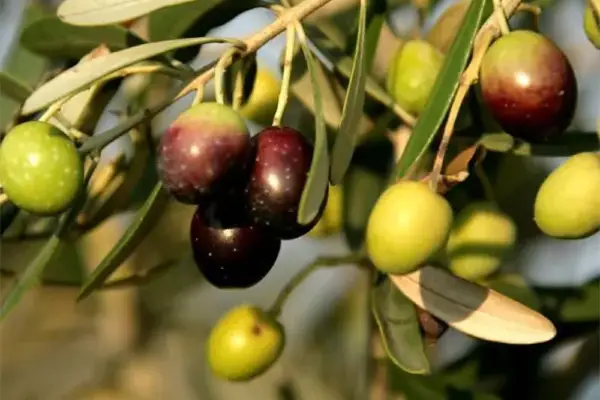
Mission Fruiting Olive
Latin Name: Olea europaea 'Mission'
Price range: $12.95 through $39.95
- Pot Size: 2 Inch, 4 Inch, 1 Gallon, 5 Gallon (Local Pickup Only)
- Hardiness Zone: Zone 8, Zone 9, Zone 10, Zone 11
Olea europaea ‘Mission’ is an evergreen olive tree with an upright, vigorous frame. Its narrow, leathery leaves are gray-green above and silver beneath. That silver comes from tiny scales that reflect light and slow water loss in dry summers. Small creamy flowers open in spring, followed by olives that ripen from green to near-black. It is a dual-purpose cultivar, grown for both table olives and pressed oil. With age, the tree settles into a broadly rounded form suited to dry-climate gardens.
Plant Details
Quick Information
- Latin Name: Olea europaea ‘Mission’
- Plant Family: Oleaceae
- Common Names: Mission Olive, California Mission Olive, Olive
- Origin / Native Range: Cultivar selected in California in the late 1700s; species native to the Mediterranean Basin
- Mature Height × Width: 25–40 ft × 20–30 ft
- Exposure Requirements: Full Sun
- Irrigation Requirements: Low
- USDA Hardiness Zones: 8–11
- Cold Hardiness: 15°F–20°F
- Bloom Time: Mid to Late Spring
- Bloom Color: Creamy White
General Information
The olive is a long-lived evergreen that changes slowly over decades. Young ‘Mission’ trees grow upright and fairly narrow. With age, the trunk thickens, splits, and twists into the gnarled shape seen in old Mediterranean orchards. Bark starts smooth and tan, then roughens to gray. Left to itself, an olive sprouts several stems and sends up suckers from the base. A single trunk usually reflects steady pruning, not the tree’s natural habit. The leaves are thick and stiff: botanists call this sclerophyllous, meaning hard-leaved. The rigid, waxy build helps the foliage handle drought and strong sun. In spring, clusters of fifteen to thirty small flowers form along the past year’s growth. Pollinated blooms become drupes, the single-seeded fleshy fruits we call olives.
‘Mission’ arose in California, but it carries the drought adaptations of a Mediterranean tree. It is built for long, rainless summers and mild, wet winters. Once established, it needs little added water. It grows well in alkaline, rocky, or fast-draining soils, as long as water never pools at the roots. It still needs real winter cold to set a good crop – olives form flower buds only after a stretch of cool weather. Among the older California cultivars, ‘Mission’ is one of the more cold-tolerant. Even so, hard freezes in the mid-teens damage branches, and longer cold below that can kill larger wood. Olive flowers are wind-pollinated and shed heavy pollen. A second olive nearby usually improves fruit set. Birds eat the ripe fruit and can carry the seed into open ground.
Few trees carry as much history as the olive: it was one of the first fruit crops grown around the Mediterranean. The ‘Mission’ selection traces to the Spanish Franciscan missions of 18th-century California. Trees planted along El Camino Real became the base of the state’s early olive oil industry. The cultivar now appears in the Ark of Taste, a catalog of heritage foods worth saving. Raw olives are too bitter to eat because of a compound called oleuropein – they are cured in brine or lye first. Two practical points are worth noting. Olive pollen is a known seasonal allergen, and some desert cities discourage fruiting olives for that reason. The dropped fruit can also stain paving and sprout where it lands, so plant it away from patios and walkways.
General Planting & Cultivation Information
Even drought-tolerant plants require regular watering until they are well established, good drainage is essential. If planting in containers, avoid pots without drainage holes.
Irrigate by watering deeply and then allowing the top several inches of soil to dry between waterings. This encourages the plant to send roots deep into the earth in search of moisture, helping it to become established, prevent root rot, build drought tolerance, and resilience to wind, heat, and cold.
The length of time between waterings will vary depending on your growing conditions and environment. Use a moisture meter for precise irrigation.
When planting, set the plant at the same depth as it was in its current container. For trees, ensure the top of the root flare is at soil level.
Young plants are vulnerable to harsh conditions, so consider growing them in larger containers until mature.
When planting in the ground, research the optimal planting season for your climate zone and protect young plants from frost.
To support establishment, consider creating a microclimate with nurse plants, shade, or wind protection. This can reduce stress, conserve soil moisture, and increase long-term success.
Protect the small, immature plants from rabbits and deer.
Check out our FAQ page for more tips on desert gardening.