Firecracker Plant
Latin Name: Russelia equisetiformis
$16.95
- Pot Size: 4 Inch
- Hardiness Zone: Zone 9, Zone 10, Zone 11
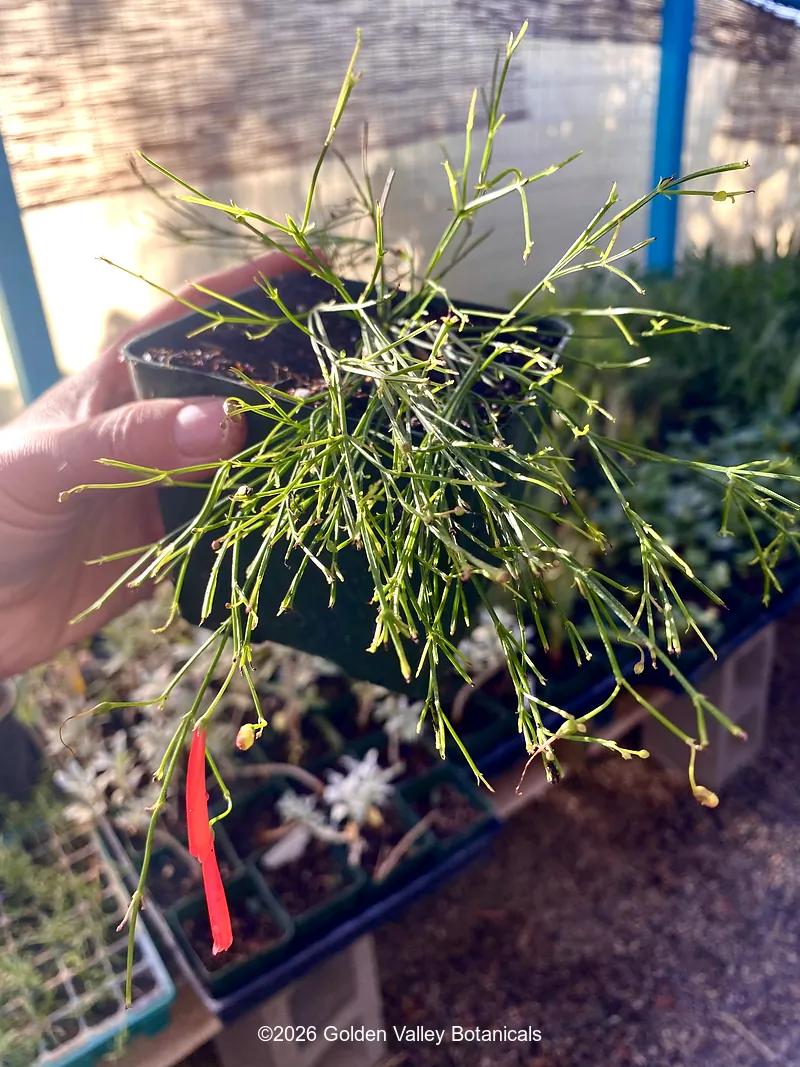
Russelia equisetiformis goes by firecracker plant or coral fountain. It forms a low, mounding shrub, and its slender green stems arch outward and spill toward the ground like falling water. Through the warm months, those stems hang with clusters of narrow, tubular scarlet flowers. Each bloom is shaped like a tiny firecracker. The stems are so fine, and the true leaves so reduced, that the plant reads as a haze of green threads flecked with red. That long, narrow flower shape is built for hummingbirds. Their bills reach the nectar pooled deep inside. Set at the top of a wall or raised bed, the plant drapes over the edge in a loose curtain.
In stock
Plant Details
Quick Information
- Latin Name: Russelia equisetiformis
- Plant Family: Plantaginaceae
- Common Names: Firecracker Plant, Coral Fountain, Coral Plant, Fountainbush, Coralblow
- Origin / Native Range: Mexico
- Mature Height × Width: 3–5 ft × 4–6 ft
- Exposure Requirements: Full Sun
- Irrigation Requirements: Low to Moderate
- USDA Hardiness Zones: 9–11
- Cold Hardiness: 20°F–25°F
- Bloom Time: Late Spring through Fall
- Bloom Color: Coral Red
General Information
A close look at the firecracker plant explains its ferny, weightless look. The slender stems are green and four- to eight-sided. They handle most of the plant’s photosynthesis, the process of turning sunlight into food. The true leaves are reduced to tiny scales that come and go, so the branches themselves carry the green. Young shoots rise upright from the base and then lengthen and arch until they tumble downward in long, trailing sprays. Along those sprays, coral-red flowers open in small hanging clusters. Each bloom is a narrow tube about an inch long, and they appear through the warm season. The fruit that follows is a small, dry seed capsule, and it is easy to overlook.
This is a plant of warm, seasonally dry country in Mexico. Its habits make sense in that light. Reducing its leaves to scales helps it lose less water under strong sun and heat. That is why it settles in so well in hot gardens once its roots take hold. It flowers most freely in full sun. In partial shade, the stems grow looser and carry fewer blooms. The tubular red flowers are a clear signal to hummingbirds. The birds feed on the nectar and move pollen from plant to plant, and butterflies visit them too. The cascading stems look best when the plant can pour over an edge or drop from a hanging basket. It also accepts some salt and reflected heat, which suits it to coastal and paved settings. Two cautions are worth knowing. Hard frost kills the top growth, but established plants often resprout from the base near the cold edge of their range. And in frost-free climates, the rooting stems can spread well beyond where they were planted.
The genus name honors Alexander Russell, an eighteenth-century physician and naturalist. The species name equisetiformis means shaped like Equisetum, the horsetails. Their jointed green stems loosely resemble these branches. The two plants are not close relatives, and the likeness is only in form. Firecracker plant belongs to the plantain family, Plantaginaceae – the same group that includes snapdragons and foxgloves. The kinship is easier to believe once you notice the tubular flowers. The leafless, green-stemmed design is a neat answer to life in bright, warm places. It is also the trait that gives the plant its fine, fountain-like texture. Nurseries offer selections in yellow, pink, and salmon, but the wild species reliably wears coral red.
General Planting & Cultivation Information
Even drought-tolerant plants require regular watering until they are well established, good drainage is essential. If planting in containers, avoid pots without drainage holes.
Irrigate by watering deeply and then allowing the top several inches of soil to dry between waterings. This encourages the plant to send roots deep into the earth in search of moisture, helping it to become established, prevent root rot, build drought tolerance, and resilience to wind, heat, and cold.
The length of time between waterings will vary depending on your growing conditions and environment. Use a moisture meter for precise irrigation.
When planting, set the plant at the same depth as it was in its current container. For trees, ensure the top of the root flare is at soil level.
Young plants are vulnerable to harsh conditions, so consider growing them in larger containers until mature.
When planting in the ground, research the optimal planting season for your climate zone and protect young plants from frost.
To support establishment, consider creating a microclimate with nurse plants, shade, or wind protection. This can reduce stress, conserve soil moisture, and increase long-term success.
Protect the small, immature plants from rabbits and deer.
Check out our FAQ page for more tips on desert gardening.